Repulsive signals: bad breath, rude manners, and ephrin ligands

Repulsive signals:  bad breath, rude manners, and ephrin ligands

Satellite cells are muscle stem cells that regenerate injured muscle (remember this earlier post?).  It seems difficult enough to repair nearby muscle, but these amazing cells may be able to travel in order to repair injured muscle far away.  This month’s image is from a paper describing signaling that can guide satellite cell migration.

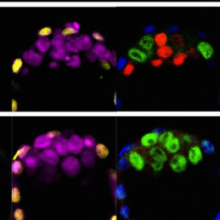
Guidance cues are signals that can attract or repel cells and axons during development.  One of the most well-understood guidance pathways is the Eph/ephrin pathway.  In this pathway, Eph receptors on a cell’s membrane interact with ephrin proteins bound to a different cell.  This interaction typically causes rapid changes in cell adhesion and architecture, and frequently causes the cells to repel each other.  A recent paper describes the role of Eph/ephrin signaling in the motility of muscle stem cells.  Stark and colleagues showed that muscle stem cells, called satellite cells, were repelled by ephrin signals using a well-established “stripe assay.”  In this assay, mouse satellite cells were able to crawl over stripes of ephrin protein coated onto glass coverslips.  As seen in the images above (increasing magnification from left to right), stripes of ephrin ligand (bottom row, blue stripes) repulsed the satellite cells, compared to the more random distribution of cells crawling over control stripes (top row).  In addition, when Stark and colleagues placed mouse satellite cells into developing quail embryos, they responded to the quail embryo’s own ephrin signals and migrated accordingly. 

For a more scientifically detailed description of this image, check out my post on The Node, the community forum for and by developmental biologists.


Credit

Stark, D., Karvas, R., Siegel, A., & Cornelison, D. (2011) Eph/ephrin interactions modulate muscle satellite cell motility and patterning. Development, 138(24), 5279-5289. DOI: 10.1242/dev.068411  

Figure reproduced / adapted with permission