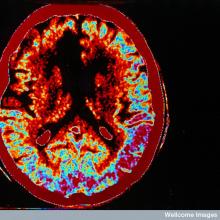
Alzheimer’s disease is caused by cell death in several areas of the brain. It is a progressive disorder that leads to loss of memory and cognitive abilities. Ultimately, Alzheimer's is fatal. There is currently no cure.
Damage to the brain in Alzheimer’s disease is widespread, making stem celli-based approaches to treatment problematic. Stem cell therapy offers greatest potential for diseases in which specific, well-known types of cell need to be replaced or helped to function correctly. In Alzheimer's disease several different groups of brain cell would need to be replaced, and scientists believe it is highly likely that the signals needed to help transplanted cells integrate into the brain may be absent in the Alzheimer brain.
Stem cells could, however, be genetically modified so as to deliver substances to the Alzheimer brain, to stop cells from dying and stimulate the function of existing cells. A recent clinical triali (Phase I) has shown this approach to be of some benefit to patients with Alzheimer’s disease, by slowing down the progression of the disease.
Relevant links:
alz.org - alzheimer's association research center - good information on the status of current research, future directions and clinical trials
Alzheimer's Society (UK)
Alzheimer Europe
In motorneuron disease (known as amyotrophic lateral sclerosis in the USA, sometimes also called Lou Gehrig’s disease) nerve cells that control movement, located both in the spinal cord and in the brain, degenerate and die. As a result, the muscles to which those nerve cells were connected eventually weaken and waste away. Patients lose their strength and the ability to move their arms, legs and body. Eventually the muscles in the diaphragm and chest wall fail, and the patient becomes unable to breathe without support.
Because nerve cells in both the spinal cord and the brain are affected in motorneuron disease, the prospect of treatment through replacement of these cells seems a distant goal. Any effective cell-replacement therapy would have to restore the function of both groups of nerve cells, and, as with other neurological disorders, ensure that the new cells become integrated into the existing circuits, so that the brain and spinal cord are able to function appropriately. For all these reasons, scientists feel that a great deal of laboratory research should be done before moving into clinical trials involving motorneuron disease patients.
Scientists believe that a more realistic approach is to use stem cells to alleviate the symptoms and even revert progression of the disease. When transplanted into the spinal cords of animals with motorneuron disease, stem cells appear to nurse the sick and injured nerve cells, preventing them from dying and improving their function. Scientists are hopeful that within the next few years they will know enough to test these treatments in patients, which they expect to be most helpful if administered shortly after diagnosis, when a patient begins to lose limb function but before paralysis sets in.
Relevant links:
The National Institute of Neurological Disorders and Stroke
Motor Neuron Disease (MND) Association
Scottish Motor Neuron Disease Association
Multiple sclerosis is an inflammatory autoimmune disease whereby the patient’s immune system destroys the protective sheath (called myelin) that envelops and protects the nerves. As a result, the flow of information in the brain and spinal cord is interrupted. Ultimately, the actual nerve cells are affected and die. Patients with multiple sclerosis show a variety of symptoms involving the nervous system, including spasms, difficulty walking, bladder and bowel problems and fatigue.
There are two concurrent components to any successful therapeutic approach to multiple sclerosis. One is to prevent damage to the central nervous system by interfering with inflammation and/or the immune system’s attack on the nerves; the other is to repair the existing damage.
Stem cells are potentially useful in both components. Clinical trials in which patients have received transplants of blood stem cells from their own bone marrow or blood have shown some benefits: a proportion of patients did not progress in the disease; others showed no improvement and others regressed. In all trials, participants went through intensive treatments to suppress their immune systems before being given the transplants.
Research using animal models has shown that it is possible to re-myelinate damaged nerves, by transplanting very young ensheathing cells (so-called precursor cells), made from embryonic stem cellsi or adult neural (brain) stem cells. However, other animal studies show that the improvements seen after injecting neural stem cells are due mainly to effects of the cells on suppressing inflammation and may, therefore, not be long-lasting. Furthermore, the inflammatory environment could destroy the transplanted ensheathing cells, which would make it necessary to treat patients with immunosupressant or anti-inflammatory drugs.
Scientists know that in the early stages of multiple sclerosis, the existing myelinating cells are able to offer some spontaneous remyelination. An important area of research is focused on finding ways to enhance remyelination from these cells.
Relevant links:
The European Multiple Sclerosis Platform
The Multiple Sclerosis Society
Multiple Sclerosis Trust
The National Insitute of Neurological Disorders and Stroke
Parkinson's disease occurs as a result of a gradual loss of a specific type of nerve cell, located in an area of the brain called the substantia nigra. These nerve cells produce a natural chemical called dopamine (they are called dopaminergic neurons). The lack of dopamine makes patients with Parkinson’s disease have difficulty in moving freely, holding a posture, talking and writing.
Stem celli-based therapies for Parkinson's disease are not yet a routine clinical procedure. Scientists are agreed that more information is needed about the causes of Parkinson’s disease and the biology of stem cells before safe, effective and long-lasting therapies can be developed.
Because a single, well-identified type of cell is affected in Parkinson’s disease, stem cells offer great potential for treatment. The basis for such treatment would be to replace the cells that have died with other identical dopaminergic neurons. These dopaminergic neurons can readily be obtained from embryonic stem cellsi in the laboratory, but there are still ethical and technical hurdles to using this source.
Dopaminergic neurons can also be obtained from fetal brain tissue. You may be aware of clinical trials where fetal brain tissue was transplanted into the brains of Parkinson's disease patients. These trials provide proof-of-principle for the approach, since in a few of these trials major and long-lasting improvements were seen in some patients. The trials also emphasized several issues that need to be resolved, one of which is the need to produce large amounts of pure, uniform cells for transplantation into patients. Recent findings also highlight a further concern about cell transplantation therapies. The fetal transplants that some patients received began to show signs of being affected by Parkinson's diease. This showed that the disease from the patient was transmitted to the tranplanted fetal cells.
Stem cells could also help Parkinson's patients by contributing to the discovery of novel drugs, which would have a much wider impact than cell therapies. We can now get embryonic-like stem cells from adults through a method called "reprogramming". By reprogramming a sample of adult, specialised cells from a patient, we can make so-called induced pluripotent stem (iPS) cellsi. These iPS cells can make any type of cell found in the body, including dopaminergic neurons. Scientists are now making iPS cells from people with Parkinson’s disease and using them to produce neurons in the laboratory. The aim is to learn more about why these nerve cells die in Parkinson's disease, and to use the cells to test for substances that could be developed into new drugs.
Relevant links:
Micheal J. Fox Foundation
Parkinson’s UK
The National Institute for Neurological Disorders and Stroke
European Parkinson’s Disease Association
Stroke is caused by a blockage of the blood supply to a region of the brain (ischaemic stroke) or when a blood vessel in the brain bursts, spilling blood into the spaces surrounding brain cells (haemorrhagic stroke). Brain cells die when they no longer receive oxygen and nutrients from the blood or there is sudden bleeding into or around the brain. Depending on the area of the brain that is affected, several functions may be impaired, including walking, talking and cognitive ability.
Stem cells are not currently used for treatment of stroke. Cells from fetal brain, bone marrow, umbilical cord blood, and embryonic tumours have yielded some improvements when transplanted into animal models of stroke. In a clinical triali in which patients received implants of nerve cells generated from a human embryonic tumour, some of the patients showed short-term improvements. In most of these cases, the transplanted cells acted by releasing substances that enhanced the survival of existing cells.
One of the favoured approaches to long-term, effective stem cell therapy for stroke is to transplant neural (brain) stem cells into patients. Ideally, these cells, generated from either embryonic or fetal brain stem cells, would then specialize into the cells that have died in the affected area of the brain. In several studies using animal models the new cells were able to move to the affected area, replace the dead cells, survive, connect to existing healthy cells and re-establish the damaged circuits of the brain.
In January 2009, UK company ReNeuron announced it had UK regulatory approval to start a Phase I clinical study of its neural stem cell treatment, which is designed to regenerate portions of the brain impaired by ischaemic stroke. The trial will test the safety of this treatment, which involves the injection of cells from derived from human fetal tissue directly into patients' brains. It is due to start mid-2009 in Glasgow with four groups of three patients over the next two years.
Another approach to stem cell therapy for stroke could be to stimulate the stem cells naturally present in the brains of stroke patients, so that they could generate replacements for the dead cells. Scientists are testing several substances for their effect on stimulating the existing stem cells.
Relevant links:
Stroke Alliance for Europe - listing of European patient organizations
The Stroke Association
The Stroke Trials Directory of the Internet Stroke Center
The National Institute of Neurological Disorders and Stroke
| © Copyright 2008-2010 EuroStemCell and contributing authors |