Glossary

Words and phrases commonly used in stem cell research

ancestor cell

General term for cell without self-renewal ability that contributes to tissue formation. In some cases it generates tissue stem cells.

Synonyms: precursor cell
asymmetric division

Cell division resulting in two daughter cells with different properties. Observed in some but not all stem cells and can occur in other types of progenitor cell.

See also: daughter cell, immortal strand
blastocyst

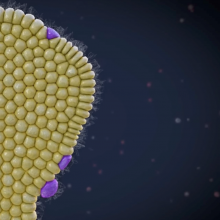
An early stage embryo of about 100 cells that has not yet implanted into the womb. The blastocysti is a sphere made up of an outer layer of cells, a fluid-filled cavity and cluster of cells inside called the inner cell mass.

cancer cell of origin

Precancerous cell that gives rise to a cancer stem celli. May be a mutated stem cell, or a progenitor cell that has acquired self-renewal capacity through mutation.

See also: cancer stem cell
cancer stem cell

Self-renewing cell responsible for sustaining a cancer and for producing differentiated progeny that form the bulk of the cancer. Cancer stem cells identified in leukaemias and certain solid tumours are critical therapeutic targets.

See also: cancer cell of origin, cancer-initiating cell
cancer-initiating cell

Cell that can produce a new cancer upon transplantation. A key property of a cancer stem celli.

See also: cancer stem cell
cell culture

The growth of cells in a laboratory dish for experimental research. The cells are grown in a solution, or medium, that contains nutrients and growth factors. Different factors can be added to the culture medium to initiate changes in cell behaviour.

cell replacement therapy

Reconstitution of tissue by functional incorporation of transplanted stem-cell progeny. Distinct from 'bystander' trophic, anti-inflammatory or immunomodulatory effects of introduced cells.

See also: regenerative medicine
clonal analysis

Investigation of properties of single cells. Essential for formal demonstration of self-renewal and potencyi.

See also: potency, self-renewal
commitment

Engagement in a programme leading to differentiationi. For a stem celli, this means it no longer retains the ability to self-renewi.

See also: differentiation
daughter cell

One of the two or more cells formed in the division of a single cell.

See also: asymmetric division
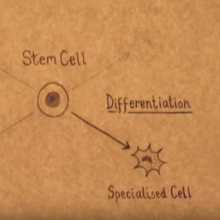
differentiation

The process by which cells become specialized to perform particular tasks.

See also: commitment
embryonic stem cell

Pluripotenti stem-cell lines derived from early embryos before formation of the tissue germ layers.

See also: pluripotent Synonyms: embryonic stem cells
germ cells

The reproductive cells in multicellular organisms.

See also: zygote
immortal strand

The hypothesis of selective retention of parental DNA strands during asymmetric self-renewal. Potential mechanism to protect stem cells from the mutations associated with replication.

See also: asymmetric division
induced pluripotent stem (iPS) cells

A type of pluripotenti stem celli derived from a non-pluripotent cell, typically an adult somatic celli, by manipulating expression of certain genes.

See also: pluripotent, somatic cell Synonyms: induced pluripotency, induced pluripotent stem cells, induced pluripotent stem (iPS) cells, iPS cells
lineage

Term used to describe cells with a common ancestry, that is developing from the same type of identifiable immature cell.

long-term reconstitution

Lifelong renewal of tissue by transplanted cells. The definitive test for haematopoietic, epidermal and spermatogonial stem cells.

multipotent

Able form multiple mature cell types that constitute an entire tissue or tissues. Example: haematopoietic (blood) stem cells.

See also: potency
niche

Cellular micro-environment providing the support and stimuli necessary to sustain self-renewal

See also: self-renewal
oligopotent

Able to form two or more mature cell types within a tissue. For example, neural stem cells that can create a subset of neurons in the brain are oligopotenti.

See also: potency
plasticity

Unproven notion that tissue stem cells may be able to generate the cell types of another tissue under certain conditions.

pluripotent

Able to form all the body's cell lineages, including germ cellsi, and some or even all extraembryonic cell types. Example: embryonic stem cellsi.

See also: embryonic stem cell, induced pluripotent stem (iPS) cells
potency

The range of commitment options available to a cell.

See also: clonal analysis, multipotent, oligopotent, totipotent, unipotent
progenitor cell

Generic term for any dividing cell with the capacity to give rise to another cell type. Includes possible stem cells in which self-renewal has not yet been demonstrated.

regenerative medicine

Reconstruction of diseased or injured tissue by activation of resident cells or by cell transplantation.

See also: cell replacement therapy
reprogramming

Increase in potencyi. Occurs naturally in regenerative organisms (dedifferentiation). Induced experimentally in mammalian cells by nuclear transfer, cell fusion, genetic manipulation or in vitro culture.

self-renewal

The ability of a stem celli to divide and produce copies of itself for an indefinite period of time. This is the defining property of stem cells.

See also: clonal analysis, niche, stem cell Synonyms: self-renew
somatic cell

Any of the cells of a plant or animal other than germ cellsi

See also: induced pluripotent stem (iPS) cells Synonyms: somatic cells
stem cell

A cell that can continuously produce unaltered daughters and also has the ability to produce daughter cells that have different, more restricted properties.

See also: self-renewal, stemness
stemness

Unproven notion that different stem cells are regulated by common genes and mechanisms.

See also: stem cell
tissue stem cell

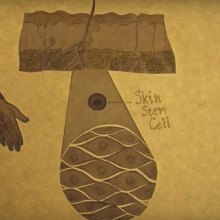
Stem celli derived from, or resident in, a fetal or adult tissue, with potencyi limited to cells of that tissue. These cells sustain turnover and repair throughout life in some tissues.

Synonyms: adult stem cell
totipotent

Sufficient to form entire organism. The zygotei is totipotenti; not demonstrated for any vertebrate stem celli.

See also: potency, zygote
unipotent

Forms a single mature cell type. For example, spermatogonial stem cells are unipotenti, as they can only form sperm cells.

See also: potency
zygote

A single cell resulting from the fusion of male and female gametes (sperm and egg) at fertilization.

See also: germ cells, totipotent