Ready or not? A Role Play on Stem Cells in the Clinic
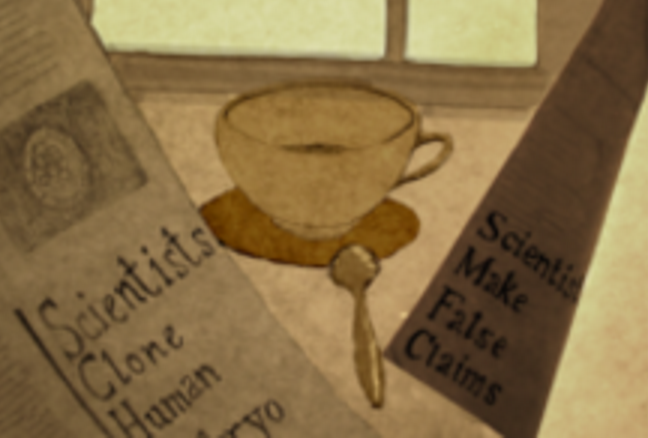 A role play exploring the issues around taking stem cells to the clinic. The scenario is an open public hearing of a research ethics committee, to decide on granting a licence for a clinical trial using human embryonic stem cells to treat spinal cord injuries. Participants role play members of the committee and different stakeholders in the audience, and in doing so engage in debates on the scientific and social issues surrounding stem cell research.
Recommended by Scottish government agency Learning and Teaching Scotland as a tool for National Qualifications support.
This resource is also available in Spanish and Gaelic.
Details and instructions
Aims
- to explore how people view a range of issues surrounding stem cell research and its applications;
- to involve people in the debates on the scientific and social issues surrounding stem cell research.
Scenario
An Open Public Hearing of a Research Ethics Committee, to decide on granting a licence for a clinical trial using human embryonic stem cells to treat spinal cord injuries. Students will role play members of the committee and different stakeholders in the audience.
Students will be provided with background information on stem cells and spinal cord injury, as well as short biography cards for their characters.
The role play can be sound recorded, to listen back to when evaluating.
Target audience
Year 11, Sixth form and undergraduate students (ages 15+). Previous Biology courses are not an absolute pre-requisite; the role play may be carried out in Biology, Modern Studies, Personal and Social Education or Religious Education classes.
After completing the role play, participants should have a better understanding of the basic scientific concepts underlying stem cell research. However, the main objective of this resource is to be an exploration of the social issues around stem cell research. It is therefore not a traditional educational package in that it has not been developed to teach the students science or social research methods.
Issues raised by role play
The role play has been designed to address the following issues:
- Why use embryos for stem cell research? What about tissue (adult) stem cells?
- What are the risks involved, compared to the benefits?
- May this type of research make human cloning more likely? Where should we draw the line?
- Who will own the results of the research and/or the medical outcomes: scientists, companies, the government, you and me?
- Who will have access to the medical benefits that are promised?
- How does competition between scientists affect research?
What participants have said about this role play:
"I would recommend this role play as it gave me an insight into the application for a clinical trial process and background into stem cell research. A very fun way of learning."
"I liked that as many as 10 people were involved in the discussion and that all possible views were represented. It was very interesting and encouraged a deeper understanding of bioethics."
"We enjoyed it thoroughly, continuing on the discussion at home that night. It really made me aware of aspects I had overlooked, it was enlightening."
Who’s who in the role play?
Ten participants are recommended. A minimum of 8 participants is necessary.
The Research Ethics Committee (REC)
Will make final decision on whether the company can go ahead with the trial, based on all the evidence, concerns and recommendations put before them, by the company and other stakeholders, and is made up of 4 members:
- Stem cell scientist from University-based research centre
- Spinal cord injury patients' group representative
- Bioethicist
- Neurosurgeon
The Stakeholder Audience
Main task is to present personal or group views, concerns, interests and expectations to the Committee:
- Student with spinal cord injury
- Pro-life activist
- Biotech entrepreneur/ CEO
- Disability rights group representative
- Pro-technology activist
- Interested member of public/ coffee shop owner
Suggested Sequence of Events
A. Pre-Open Public Hearing (45 or 60 min session; possibly one week before hearing)
- Introduce the role play
- Screening of the films ‘A Stem Cell Story’ (15min) and 'Conversations: ethics, science, stem cells' (19min)
- Supply all participants with background information (Introduction, Clinical Trial application, background information on stem cells & spinal cord injury)
- Allocate roles to the participants; distribute biographies. Elect Research Ethics Committee Chairperson.
- Committee Chairperson calls Open Public Hearing to be held at next session
Participants can prepare for the hearing by reading the information that they have received and/or view the films ‘A Stem Cell Story’ and 'Conversations'. They are also encouraged to research the character they have been assigned, for example, using this website.
B. The Open Public Hearing and Discussion (2-2.5 hour session)
- Welcome note by Chairperson of the Committee
- Audience speakers intervene. Research Ethics Committee (REC) members and audience stakeholders ask each other questions (20-30min)
- The Committee meets to make a decision. Audience meets separately to discuss expected outcomes of the hearing (20min)
- The REC announces its decision. Audience reacts to the decision (20min).
- Participants come out of character for discussion and feedback (20-30min).
C. Meeting of all role play participants
All groups (participants and ‘real-life’ characters who have run the role play) come together informally, in a non-hierarchical setting, to discuss common issues raised by the role play.
Participants and facilitator(s) will be asked to fill out short questionnaires which will feed back into any changes made to the role play. All feedback and the decision reached by the Research Ethics Committee will be published on the EuroStemCell website.
Material and Equipment
The role play can be carried out in a classroom, other room or even outdoors. The layout should be that of a public hearing: tables with chairs (for 4 people) facing a seated audience. The materials include:
- Introduction, Application for clinical trial, background on stem cells & spinal cord injury (provided)
- Biography cards (provided)
- Paper and pens/pencils
- Camera (video or still)
- Tape recorder