About NeuroStemcell
NeuroStemcell brings stem cell biology and clinical science together to develop and test new approaches to stem-cell-based therapy. We study Parkinson’s (PD) and Huntington’s (HD) diseases, which are degenerative diseases of the brain. In each of these diseases, specific types of neurons (nerve cells) die: dopaminergic neurons in PD and striatal neurons in HD. Our main strategy is to produce neurons in the lab that, if our approaches are successful, may in future be transplanted into patients. To make these neurons, we start from all the available stem cell types (embryonic, fetal, adult, reprogrammed) and compare the ability of cells from these different sources to generate the desired neurons.
How does NeuroStemcell work?
NeuroStemcell has six interconnected areas of research, called Work Packages (WP):
- WP1: Production of specific neurons from stem cells.
- WP2: Selection of the best cells in culture to be transplanted into animal models for testing.
- WP3 & 4: Studies aimed at understanding whether the transplanted cells survive, differentiate and integrate into the damaged brain areas.
- WP5: Systems to help bring the findings of the whole NeuroStemcell project into the clinic: How can the cells be maintained safely until they are used in the clinic? How can we obtain the right number of cells needed for treatment? What kind of quality controls do we need to place on cells for transplantation?
- WP6: Consideration of the clinical, societal, ethical and regulatory requirements for bringing the results of the research to patients. This area of work provides guidance to scientists in other parts of the project, helping us to bring results to patients.
The main objective
One of our main objectives is to compare different procedures (protocols) for differentiating stem cells into neurons. We aim to generate the types of neurons that die in PD and HD in the controlled environment of the flask (in vitro), rather than in a living organism (in vivo).
Approach 1: One approach to generate a specific kind of neuron (e.g. striatal or dopaminergic) is to put certain genes (pieces of DNA) into the stem cells. We add genes that give the cells the characteristics of the desired type of neuron. For example, the genes named Lmx1a, Dmrt5 and Nurr1 are used to push mouse and human stem cells to make neurons called TH+ (‘TH positive’) neurons. TH is one indicator, or marker, that identifies dopaminergic neurons – the kind of cell that dies in Parkinson’s Disease. This is possible because of a property of stem cells known as 'plasticity': if well instructed, these cells are able to transform (differentiate) into different cells of our body, including the neurons we hope to produce.
Approach 2: We use established human embryonic stem cell lines and expose them to particular molecules (like oxysterol or Wnt) that are important for increasing the number of neurons grown in the flask. We can also enhance the number of neurons produced by introducing an ’indicator’, or reporter gene into the cells. We select a reporter that turns on when the cells reach a desired step in the process of differentiation, or maturation. This allows us to identify and select specific subgroups of ’intermediate‘ cells that may be more prone to generate the desired neurons in vitro or after transplantation.
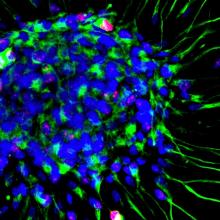
Neurons grown from human embryonic stem cellsApproach 3: We are developing protocols to obtain stem cells that already have a brain ’character‘. These stem cells are more specialized than embryonic stem cells. They have different names, depending on their characteristics – they are known as NS or lt-NES cells. They can be maintained in culture for a long time and are able to differentiate into neurons with high efficiency. These cells can also be transplanted into the brains of animals with Parkinson’s and Huntington’s diseases. We have found that in animal models, the newly generated neurons integrate with those already existing in the brain.
Approach 4: We also take advantage of an ’artificial‘ stem cell type called induced pluripotent stem (iPS) cells. These can be derived from patients by reprogramming their skin cells with a cocktail of genes normally turned off in adult specialized cells. The resulting iPS cells can be used as disease models in research and to test new drugs. In the future, it would be theoretically possible to use specific cells derived from a patient's own iPS cells to replace lost or damaged cells in the body, avoiding immune rejection risks.
Grafting cells for cell replacement therapies
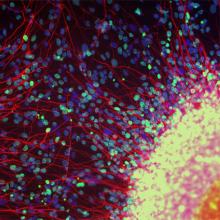
Neurons grown from human embryonic stem cells and transplanted into a ratCells that are generated in vitro have to be grafted into animal models for testing. These studies define the pre-clinical phase of our program and are aimed at proving or disproving the validity of a given cell type for use in studies of treatments for a given disease. This is an essential step before application in humans.
First, we select the cells that are most likely to become neurons by using a technique called FACS, or fluorescence-activated cell sorting. This technique allows us to separate out particular cells from a mixture by labelling them with a fluorescent substance. Then we need procedures, or protocols, for transplanting cells into animals: in particular, we have developed protocols to allow us to identify and compare side effects of the graft, and check for the possibility that new cells are rejected from the body or that tumours are formed - common risks in these experimental stages.
Understanding the graft
We use imaging techniques like magnetic resonance imaging (MRI) to observe and analyse how cells behave once they are in the body. We have found that transplanted stem cells are sometimes able to differentiate, but this process is not efficient. New efforts are necessary to find ways of making sure that newly generated donor cells produce exactly the neurons needed once they are in the body. The neurons must have exactly the right properties: quality, quantity and capacity to integrate with the body’s own cells in a working fashion are all essential.
Results of the grafts
NeuroStemcell has achieved a number of successful transplants in animal models of Parkinson’s Disease. The transplanted cells survived and integrated into the damaged area of the brain. This leads us to believe that cell replacement might represent a strategy that can be used in the future to treat neurodegenerative diseases.
Where can cell lines be stored and maintained? And how should possible therapies be regulated?
One important aspect of stem cell research is to develop a depository (or cell bank) where the cell lines generated by the scientific community can be stored and distributed to researchers. It is not easy to maintain the cells in good condition or to move them from place to place. To solve this issue, several companies are working to develop methods of conservation and to create biobanks that gather cells from different labs all around Europe. Finally, before any discovery is brought to the patient it is extremely important to define a series of requirements and rules for the future application of these findings to patients.
Beyond and around science
Staminalia: an innovative theatre production
Science is a public endeavour. It is conducted on behalf of societies so that unknown territories can be explored and knowledge used for the benefit of humankind. NeuroStemcell aims to share with the public any knowledge developed within its field of expertise. We are doing this by setting up several communication projects in collaboration with other groups and EU-funded research consortia. One example is the theatre play, ’Staminalia: a dream and a trial‘, which describes the fierce political disputes that have erupted over stem cell research. Another initiative is the documentary, ’Behind the Science’, which describes what happens behind the scenes in the process of organising and carrying out science. NeuroStemcell is also a contributor in the development of eurostemcell.org as Europe’s stem cell hub, and we are involved in national and international activities focused on training and dissemination for more specialised groups.
Further information
Useful scientific background and further information for patients::
- EuroStemCell factsheets for more information on iPS cells
- EuroStemCell frequently asked questions about neurological diseases and stem cell research
- A description of how FACS sorting works
- More about Huntington's disease from HDBuzz
- More about Parkinson's disease from Parkinson's UK
More on NeuroStemcell and its research:
Acknowlegements and Image credits
Report by Anastasia Andriotto, Elena Cattaneo, Gianni Munizza, Marco Onorati.
Scientific images from the laboratories of Stephen Dunnett and Elena Cattaneo. Staminalia performance pictures by Davide D’ortona (www.davidedortona.com)